Just for the hell of it, I thought I'd post an essay I wrote for a rock 'n' roll history class, back in 2001. I don't think the TA - a graduate student in percussion - had any idea what to do with the paper, short of marking it an A and moving right along. So here goes, all 1,800 words, only altered by chopping it into more paragraphs to make the online reading easier:

The New Jersey shore in the early 1970s was filled with boardwalk towns and a carnival atmosphere, a working class escape where youth flourished and struggled – looking for some mystical enlightenment and all the while playing it cool. Under this umbrella Bruce Springsteen created his own lyrical world, filling his songs with wild, fantastic characters and tied their experiences together with the thematic threads of magic, love and most importantly unbridled youth.
The characters in Springsteen’s 1973 classic album
The Wild, The Innocent and the E Street Shuffle are all recreations and re-emergences of those Jersey shore youths, spun through the songwriter’s own experiences and desires. They form a curious and odd collection, often times charicatures thrown over the top. But their desires run through to the root of human experience – the assertive nature of youth not allowing itself to be kept down and in the search for love especially, demanding of a free spirit.
Springsteen’s lyrics on the album can be seen as a contemporary version of the 17th century English Cavalier poets. The two most accomplished of the group, Andrew Marvell and Robert Herrick, built their poetry out of a carpe diem longing. On
The Wild, The Innocent and the E Street Shuffle, Springsteen’s lyrics are comparable to Marvell and Herrick’s classic “seize the day” poems, extending the themes to the contemporary listener while staying true to the tradition.
First examining simply the title of the album,
The Wild, The Innocent and the E Street Shuffle, is rooted in the idea of
carpe diem. The characters are wild and innocent – a seeming contradiction but once examined in terms of eagerness and youth lends itself to a more accurate description.

The spirit of youth infuses each of the lyrical characters and one of the prime components of that spirit is a longing for action and adventure, an eagerness to experience the wonder of life. The E Street Shuffle, named for Springsteen’s band, advances the idea, giving the characters a perfect setting for adventure and permission to dance. But while it encompasses the thematic material for the album, the title is simply an introduction, giving context to the lyrics that follow.
Springsteen’s “New York City Serenade” captures the idea that the present must be embraced fully because once the age of youth has passed it is lost forever. This idea is central to Herrick’s “To the Virgins, to Make Much of Time” as well. Herrick advises his audience to “use your time / And while ye may, go marry.” This assertion relies heavily on the conception of time as a fleeting definition of youth. Indeed it is, as Springsteen also recognizes.
The “New York City Serenade” protagonist, Billy, is waiting for his Diamond Jackie at midnight in Manhattan and makes his motto “walk tall or baby don’t walk at all.” This assertion of giving one’s all to the pursuit of youthful experience would rightly serve as a motto for Herrick’s poem. Herrick continues his advice by announcing that “having lost but once your prime, / You may forever tarry.”
Springsteen utilizes this idea of man in his prime – and conscious of that fact – remarkably well. Billy says to Diamond Jackie “I’m a young man, I talk it real loud / Yeah babe I walk it real proud for you.” Here Springsteen expands Herrick’s message by giving it a specific listener, one to whom the message is crucial. The intrinsic implications of Herrick’s addressing the poem “To the Virgins” give the message an audience and urgency, while Springsteen builds on that to confine the audience to one character and increase the sense of urgency.

Herrick opens his poem by telling the youth to “Gather ye rosebuds while ye may, / Old time is still a-flying; / And this same flower that smiles today, / Tomorrow will be dying.” The potential for decay underlies this message and enforces the assertion that the present is the only suitable time for action. But Herrick does not examine the possibility that while the prime is suitable for gathering rosebuds (in other words collecting positive experiences), it is also the crucial moment for breaking away of negative situations.
Springsteen does bring in this sentiment, which is crucial to the contemporary audience. Billy employs Diamond Jackie to “shake away your street life / Shake away your city life / Hook up to the train.” Here Springsteen’s character not only gives the push to take the reins of life, he also points the way to a direct method. Just as Herrick’s 17th century poem implores his audience to embrace the prime of youth and accomplish all that is possible before that window so quickly slams shut, Springsteen brings the same themes into his rock ‘n’ roll, carving his lyrics just as delicately as the classic poet did.
Another of the Cavalier poets, Andrew Marvell, expanded Herrick’s use of the carpe diem theme in “To His Coy Mistress.” He discusses a courtship under the umbrella of “had we but world enough, and time,” as a device to hint at what immortal life could accomplish. But, as he later describes, “Time’s winged chariot (is) hurrying near,” which does not allow for a subtle courtship.
In “4th of July, Asbury Park (Sandy)” Springsteen again echoes back to the carpe diem poets as his narrator tries to speed up a courtship. He tells his Sandy that “this pier lights our carnival life forever / Love me tonight for I may never see you again.” Springsteen is equally effective as Marvell in evoking the idea that if a young man had a forever, he would use it in courtship, but since time is fleeting the process should occur quicker.

Again Springsteen has mastered the same sense of urgency that the Cavalier poets relied on. Marvell’s narrator is asking his beloved “let us sport us while we may” and “tear our pleasures with rough strife / Thorough the iron gates of life.” Springsteen returns with another echo of the carpe diem theme, albeit much updated for his Jersey shore characters. The narrator tells his Sandy that “for me this boardwalk life is through / You ought to quit this scene too.” Both passages focus on the moment of initiative – that one second when the characters choose to embrace the possibility of youth and act with all their being to make the fleeting prime all that it may be.
Just as Marvell is asking his beloved for immediate love in exchange for permanent love, Springsteen closes the song with the line “Oh love me tonight and I promise I’ll love you forever.” Despite the more than 300 years separating Marvell and Springsteen, the contemporary songwriter has recognized the universality of his elder’s themes and created a song both inspired by and using many of the same techniques and implications of language as the classic.
The Wild, The Innocent and the E Street Shuffle’s most well known and enduring track, “Rosalita,” is perhaps the best example of the parallels between the album and the writings of the Cavalier poets. The song focuses most heavily on the insistence that youth must be embraced almost to the point of exploitation. Marvell’s description of the prime of one’s life is in the line “while the youthful hue / Sits on thy skin like morning dew, / and while thy willing soul transpires / At every pore with instant fires.” He brings in the notion of unadulterated enthusiasm and an immediacy of action.
Springsteen sings “Spread out now Rosie, doctor come cut loose here mama’s reins,” giving the opening line of the song an equal sense of enthusiasm and immediacy. The “mama’s reins” still intact speak to the youthful nature of Rosalita, but also to the necessity to break out, as the narrator will urge throughout the rest of the song.

Herrick’s description of youth is “that age is best which is the first, / When youth and blood are warmer.” Springsteen takes that reference to the first age and warmer blood and renders is with much more specificity. He describes his narrator’s existence in that first age in the lines “We’re gonna play some pool, skip some school, act real cool / Stay out all night, it’s gonna feel alright / So Rosie come out tonight.”
The request for Rosie to come out roots itself in the conception of “time,” which Marvell uses particularly well. The most effective and evocative moment in which Springsteen directly uses the idea of time is in the line “By the time we meet the morning light I will hold you in my arms.” Here he is more direct than his
carpe diem ancestors, but given the three-century difference, the directness is well understood.
Despite all of the other similarities in theme, use of language and invocation of the classic call to action, there is one image in “Rosalita” which parallels the
carpe diem poets better than any. Marvell closes his poem with the line “Thus, though we cannot make our sun / Stand still, yet we will make him run.” This statement asserts that even though time cannot stop, the narrator and his love can by their own actions take charge and make the sun (time) operate at their mercy rather than be themselves passively controlled.
Springsteen directly references that line in “Rosalita” when he sings “And together we’re gonna go out tonight and make that highway run.” He substitutes the highway for the sun (which expands the notion to include space as well as time), but the motif remains intact – during the age of youth, one has the power to exert control over time rather than being forced to accept what it may deliver.
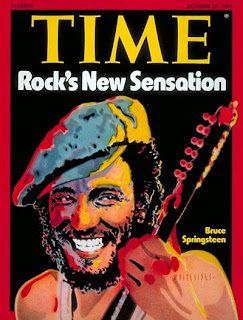
The notion that rock ‘n’ roll lyrics can function as literature is indeed correct, but leaving off at that does not offer any further insights. Only by comparing the lyrics to respected literature can the real depth of meaning of rock lyrics emerge. Bruce Springsteen, once hailed as the new Bob Dylan for his command of the language and ability to craft songs that evoke themes central to the human experience, delivered, on
The Wild, The Innocent and the E Street Shuffle, a collection of lyrics that can be best understood in relation to the classic
carpe diem poetry of the 17th century.
The thematic links are obvious – the undeniable essence of youth to create for itself in light of an understanding that the opportunity is short. However, the techniques Springsteen employs – metaphor, imagery and characterization in particular – also render him as a contemporary equal to Robert Herrick and Andrew Marvell. From 17th century England to the Jersey shore, the necessity to “sieze the day” permeates because it is one of the central ideas of humanity. And those rare few who can effectively capture that will forever be considered classics.
DOWNLOAD:
Bruce Springsteen - New York City Serenade (live, 1973)Bruce Springsteen - 4th of July, Asbury Park (Sandy) (live, 1974)Bruce Springsteen - Rosalita (live, 1974)


